2. Sample mid-term questions I#
2.1. A. Beers law#
Stull page 2.43 and the Beers and inverse squared laws reading:
Prove that for a thin non-reflecting layer the change in emissivity = change in optical thickness, i.e. prove that:
(2.1)#\[ \Delta \epsilon_\lambda \approx \Delta \tau_\lambda \]Repeat the problem above, but for a layer with an optical depth of \(\tau_\lambda=1\). How does that change (2.1) ?
Suppose you put ozone molecules in a 1 km long tunnel and measure an optical thickness of 0.5 using an ultraviolet laser. You know that the ozone mixing ratio is 1 g/kg and the air density is 1 kg/\(m^3\). What is the extinction coefficient \(k\) in \(m^2/kg\)?
Find the narrow beam transmissivity, absorptivity and emissivity for a series of stacked layers of equal transmissivities and temperatures in a direction perpendicular to the layers.
2.2. B. Solid angle and radiance#
From Solid angle and radiance reading:
Calculate the solid angle subtended by a cone with an angular width of \(\Delta \theta\) =20 degrees.
A laser pointer subtends the same solid angle as the sun: \(7 \times 10^{-5}\) sr. You shine it at a wall that is 10 meters away. What is the radius of the circular dot?
What is the angle of the cone if \(\omega = 7. \times 10^{-5}\ sr\)?
A satellite orbits 800 km above the earth and has a telescope with a field of view that covers 1 \(km^2\) directly below it (i.e. at nadir). If that 1 \(km^2\) is ocean with an emissivity \(\epsilon =1\) at a temperature of 280 K, calculate the surface flux in \(W\,m^{-2}\) reaching the satellite between 10-11 microns, assuming no atmospheric absorption or emission.
Suppose that a satellite’s orbit changes from a height of 800 km to a height of 600 km above the surface. If the telescope field of view stays the same, prove that the radiance stays constant.
For B.4 use the following figure to calculate the surface emission:
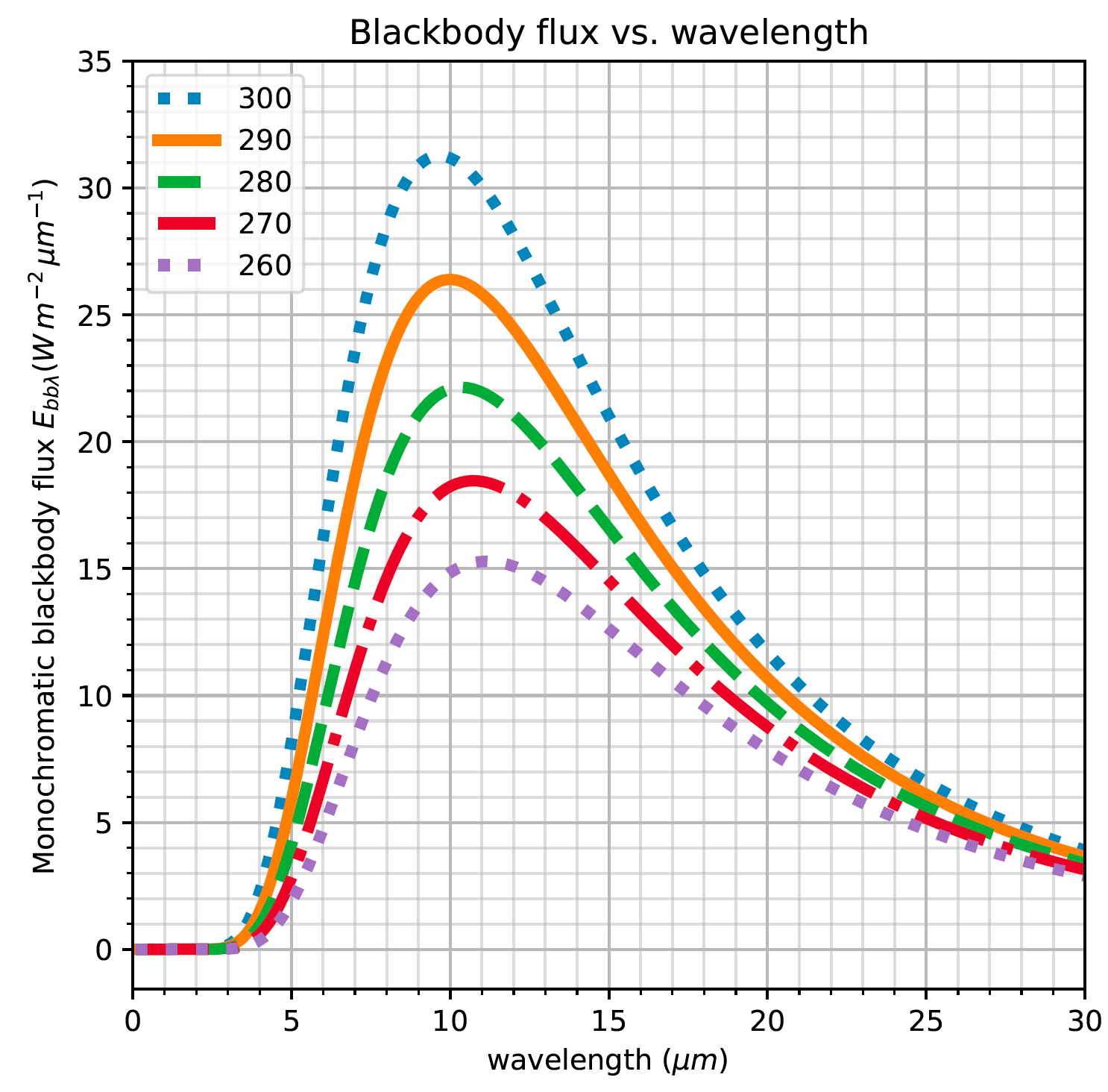
Fig. 2.1 Flux E from a perfect blackbody#
2.3. C. Schwartzchild equation#
From Stull p. 224 and the The Schwartzchild Equation reading:
Show that \(e_\lambda\) = \(a_\lambda\) for a gas that absorbs and transmits but doesn’t reflect. (hint: put the gas between two black plates, assume that the gas and the plates are at the same temperature and show that the 2nd law is violated if \(e_\lambda \neq a_\lambda\)
Integrate the Schwartzchild equation
\[ \begin{gathered} \label{eq:sch1} dL_{\lambda,absorption} + dL_{\lambda,emission} = -L_\lambda\, d\tau_\lambda + B_\lambda (T_{layer})\, d\tau_\lambda \end{gathered} \]across a constant temperature layer of thickness \(\Delta \tau_\lambda\) over a surface emitting radiance \(L_{\lambda 0}\) and show that the radiance at the top of a constant temperature layer is given by:
\[ \begin{gathered} L_\lambda = L_{\lambda 0} \exp( -\Delta \tau_\lambda ) + B_\lambda (1- \exp( -\Delta \tau_\lambda))\end{gathered} \]Hint:
See the section “Adding emission to Beers law” in the The Schwartzchild Equation notes.