34. Assignment 3: solutions#
WH 4.43, 4.46, 4.47
34.1. Question 4.43#
Consider radiation with wavelength λ and zero zenith angle passing through a gas with an absorption coefficient of \(k_\lambda\) = 0.01 \(m^2\,kg^{-1}\). What fraction of the beam is absorbed in passing through a layer containing 1 \(kg\,m^{-2}\) of the gas? What mass of gas would the layer have to contain in order to absorb half the incident radiation?
34.1.1. 4.43 Answer#
The equation: use eq. 4.31 for constant absorption coefficient, which can come out of the integral. Since they don’t mention a mixing ratio \(r\), we can assume that it’s the only gas, so \(r\)=1. Also \(\theta = 0\) so \(\sec \theta = 1\). Assume the setup is that the radiation is coming down in a direct beam from above (sunlight), so we can define the mass above z as \(M\ (kg\,m^{-2}\)) where:
Then Beer’s law says:
with \(\sec \theta\)=1 and and absorption coefficient \(k_\lambda\) both constant with \(z\)
The numbers:
Column mass needed for 0.5 absorption:
import numpy as np
print(f"{np.exp(-0.01)=:.2f}")
print(f"{np.log(0.5)=:.2f}")
np.exp(-0.01)=0.99
np.log(0.5)=-0.69
34.2. Question 4.46#
Consider a hypothetical planetary atmosphere comprised entirely of the gas in Exercise 4.43. The atmospheric pressure at the surface of the planet is 1000 hPa , the lapse rate is isothermal, the scale height is 10 km , and the gravitational acceleration is 10 \(m\,s^{-2}\). Estimate the height and pressure of the level of unit normal optical depth.
34.2.1. 4.46 Answer#
Again, the mass of the column as \(M = \int \rho dz\)
Hydrostatic equation:
Height at 1000 Pa given \(p_0 = 10^5\ Pa\) and H = 10 km
np.log(1.e-2)
np.float64(-4.605170185988091)
34.3. Question 4.47#
(a) What percentage of the incident monochromatic intensity with wavelength λ and zero zenith angle is absorbed in passing through the layer of the atmosphere extending from an optical depth τ_λ=0.2 to τ_λ=4.0 ? (b) What percentage of the outgoing monochromatic intensity to space with wavelength λ and zero zenith angle is emitted from the layer of the atmosphere extending from an optical depth τ_λ=0.2 to τ_λ=4.0 ? (c) In an isothermal atmosphere, through how many scale heights would the layer in (a) and (b) extend?
Here’s the setup:
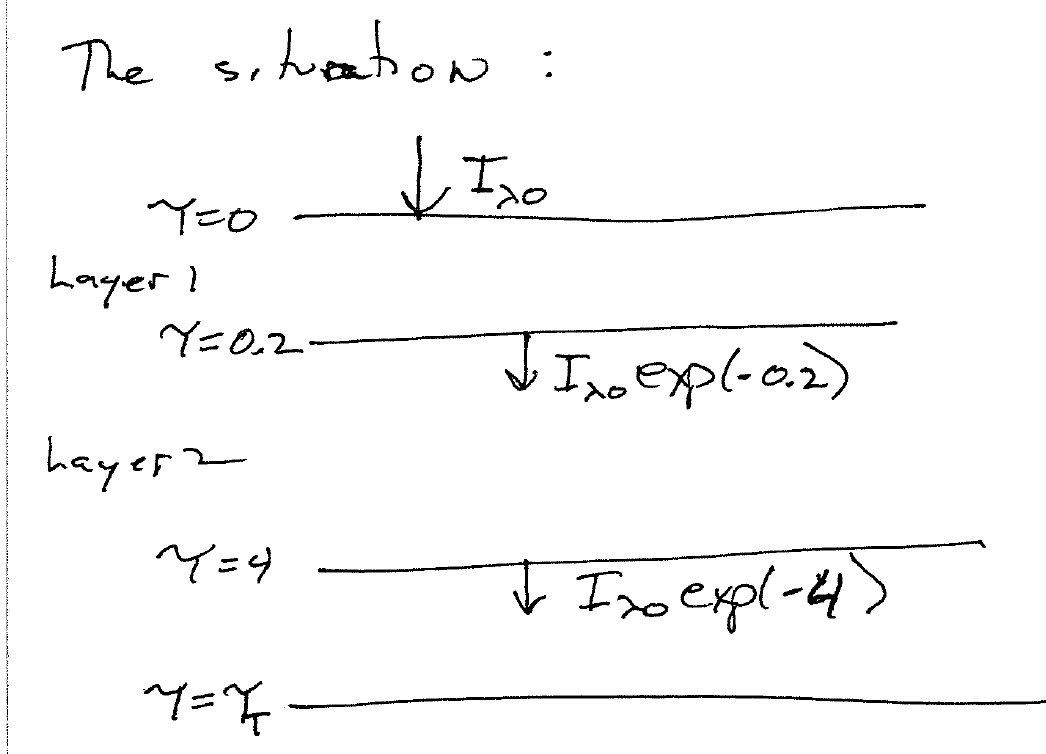
Fig. 34.1 Setup for Problem 4.47#
34.3.1. 4.47 Answer#
a) As with Optical depth II: mean free path, to find the amount absorbed we just need to take the difference between the amount arriving at \(\tau = 0.2\) and the amount that makes it to \(\tau = 4\). So if the fraction absorbed is \(f\), then
np.exp(-0.2), np.exp(-4)
(np.float64(0.8187307530779818), np.float64(0.01831563888873418))
b) Assume that the layer is thick enough so that for the entire layer, emissivity \(\epsilon\) = 1, i.e. the total optical depth \(\tau_T\) is very large. Also assume that we’re again dealing with an isothermal layer. Then the question can be phrased as “what’s the emissivity of the part of the atmosphere between \(\tau = 0.2\) and \(\tau = 4\)?”. If we call that emissivity \(\epsilon_L\), then for an isothermal atmosphere the emitted radiance is going to be \(\epsilon_L B_\lambda\).
First find the emissivity between \(\tau = 0\) and \(\tau = 4\). We know that emissivity = absorptivity, and without reflection absorptivity = 1 - transmissivity. So the emissivity from \(\tau = 0 \rightarrow 4\) is:
and the emissivity from \(0-0.2\) is
So the total emitted from \(\tau = 0 \rightarrow 4\) is \(\epsilon_{0-4} B_\lambda\) and the amount emitted from \(\tau = 0\rightarrow0.2\) is \(\epsilon_{0-0.2} B_\lambda\). The fraction f emitted is just the difference between those two amounts divided by the total blackbody emission \(B_\lambda\):
i.e., just another way of saying that 1 - transmissivity = absorptivity = emissivity
c) Assume the density scale height is \(H\), so that
From part a) the defintion of the optical depth is
Integrating this:
If we say that \(\tau_1 = 4\) occurs at height \(z_1\) and \(\tau_2 = 0.2\) occurs at heigh \(z_2\), then
Take the log of both sides:
So the difference between the heights is 3 scale heights.
np.log(0.05)
np.float64(-2.995732273553991)