10. Finding the flux given the radiance#
10.1. Law of the cosine – using power#
Unless the sun is directly overhead, the flux \(F\) on a level surface is going to be less than the flux perpendicular to the solar beam. The figure below shows the geometry:
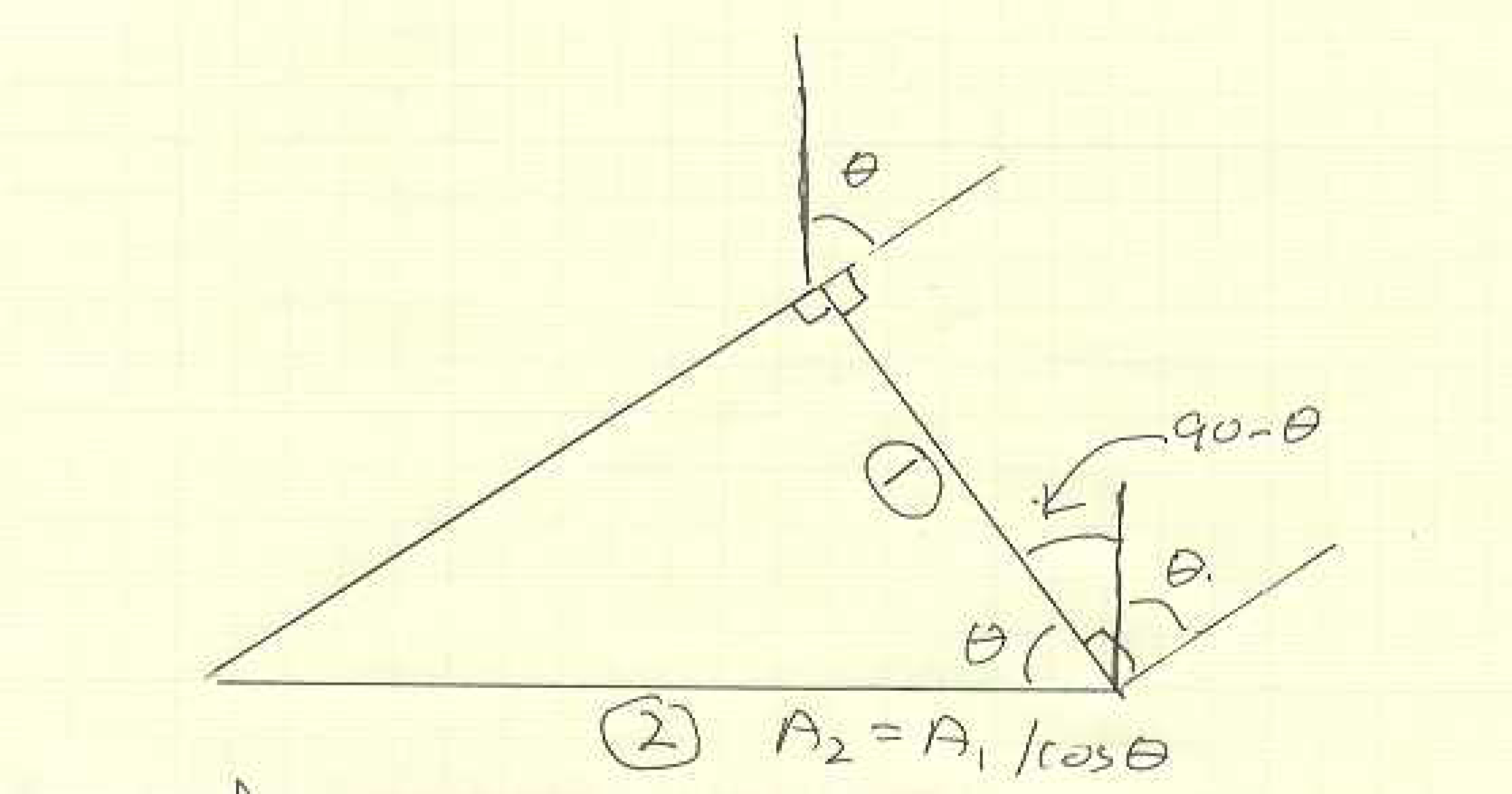
Fig. 10.1 \(\cos \theta\) effect#
Assuming that the y dimension (into and out of the screen) has unit length, then if flux \(F_1\) \((W\,m^{-2})\) is incident on surface 1, power flowing through surface 1 is:
\(P_1 = F_1 \times A_1\) Watts
If we assume a direct beam of sunlight (so no inverse-square spreading), then all of that power passes through surface 2, and so the flux perpendicular to surface 2 is:
\(F_2 = P_1/A_2 = P_1/(A_1 /cos \theta) = F_1 \cos \theta\)
This is the main reason why it’s cooler at sunset than at noon. It is also the reason your shadow can be taller than you.
10.2. Moving between flux and radiance#
We saw in the Solid angle and radiance reading that in the case that we have a very narrow beam of solid angle \(d\omega\), the flux and radiance vectors are related by:
where we are writing \(dF\) to indicate that you need to integrate this equation over a (possibly imaginary) flat surface to get the flux. This is just Wallace and Hobbs equation 4.5 without the integral signs, in the particular case that we are looking straight down at the surface, i.e. \(\theta =0\) an \(\cos \theta\) = 1.
A good way to think about this to ask yourself how a satellite would measure the radiance I in some direction. It would need to:
measure the power P reaching its sensor that has area A
Calculate the flux F= P/A
Divide that flux by the wavelength range of its filter (say \(\Delta \lambda = 1\ \mu m\)) to get the monochromatic flux:
Multiply the monochromatic radiance by the field of view of the telescope \(\Delta \omega\) to get the relationship between the monochromatic irradiance and radiance for a narrow beam:
Repeating this figure from the Solid angle and radiance reading:
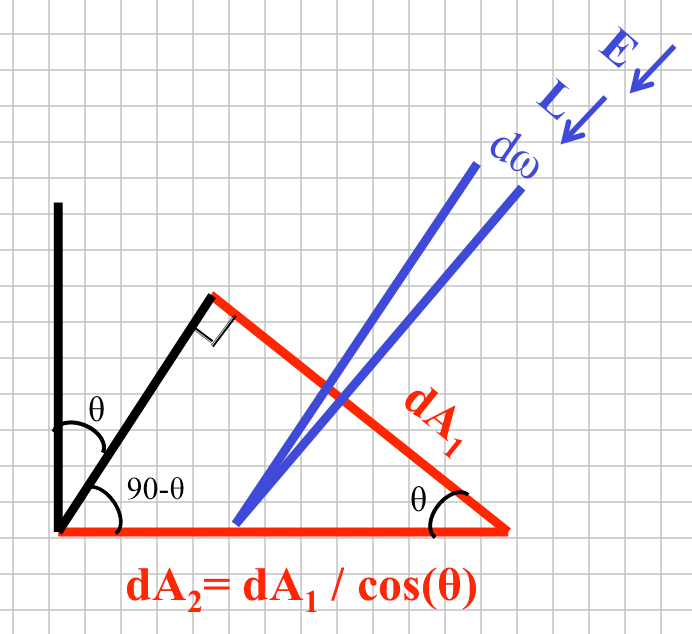
Fig. 10.2 Relationship between I and F#
So how would you calculate the flux F crossing through the bottom of this triangle if you knew the radiance I at every angle? Now you need to use the law of the cosines to move from the perpendicular surface with area \(dA_1\) to the surface you are interested in with larger area \(dA_2 = dA_1/\cos \theta\):
To get the flux from every angle requires that you integrate over a hemisphere. That means you need to integrate over all azimuths, so \(\phi = 0 \to 2\pi\) and over 90 degrees of zenith, so that \(\theta = 0 \to \pi/2\), which is done in Wallace and Hobbs exercise 4.3 on page 113:
Note that you always do this integral over a plane surface containing the sensor. That is, if you are interested in emission from the earth’s surface, you need to turn Fig. 10.2 upside down, and look downward at the source of the radiation.
10.2.1. Two approximations to (10.3)#
Equation (10.3) is the formal definition of \(F\) and is always correct. There are two simplifications that are extremely useful:
10.2.1.1. Parallel beam approximation (W&H p. 116)#
This holds when:
the \(\Delta \omega\), the total solid angle of interest is very small, so that \(I\) can be moved out of the integral because it doesn’t vary
the beam is directly parallel to the surface of interest, so that \(\theta \approx 0\) and \(\cos \theta \approx 1\)
In this case it’s typical that the approximation \(\Delta \omega = A/R^2\) is good enough (we’ll do a problem on this)
10.2.1.2. Isotropic radiance: \(F = \pi B\)#
This is Wallace and Hobbs Exersize 4.3 on page 116. Here we’re using the WH notation for the Planck function radiance: the letter \(B\) (\(W\,m^{-2}\,sr^{-1}\))
A common case in this course is thermal emission or diffuse reflection, which is characterized by photons coming isotropically from all directions. In the thermal case the surface emitted radiance \(B^*\) is independent of \((\phi, \theta)\) and can be taken outside of the integral. With that simplification, we’re down to trigonometric integrals from first year calculus:
where we’ve continued to use an asterisk to denote that this is the radiation coming from a black surface, immediately above the surface.
More generally if we know \(I\) anywhere in space and know that it is independent of direction, then the irriadiance at that point is going to be:
10.3. Worksheet questions#
Suppose you have a radiometer with a zoom telescope that can focus on 1 \(km^2\) pixel at any distance. If the surface is emitting radiance \(I\) in all directions into a hemisphere, find both \(F\) and \(I\) at 10 km above the surface, and at 100 km above the surface, assuming you can use the parallel beam.
In the answer to 1) you should have found that I is independent of distance from the surface. Explain why (10.5) doesn’t violate the inverse square law for flux F.
Find the solid angle for a 1 \(km^2\) pixel viewed from 800 km, and compare that result to \(Area/R^2\).
Change of variables: Do W&H Exercise 4.13 to prove relationship 4.4