25. Assignment 2: solutions Part A#
WH 4.21, 4.30, 4.31
25.1. Question 4.21#
Show that for small perturbations in the Earth’s radiation balance
where \(T_E\) is the Earth’s equivalent blackbody temperature and \(F_E\) is the flux density of radiation emitted from the top of its atmosphere. [Hint: Take the logarithm of the Stefan-Boltzmann law (4.12) and then take the differential.] Use this relationship to estimate the change in equivalent blackbody temperature that would occur in response to (a) the seasonal variations in the sun-Earth distance due to the eccentricity of the Earth’s orbit (presently \(\sim 3.5 \%\) ) and (b) an increase in the Earth’s albedo from 0.305 to 0.315 .
25.1.1. 4.21 Answer#
4.21) Some definitions:
Note – I’ll use \(d\) instead of \(\delta\) to denote a small change, except I’ll write \(\delta d\) since \(dd\) looks strange.
\(A\): albedo
\(Q\): power output of the sun (W)
\(d\): sun-earth distance (m)
\(S_0=\frac{Q}{4 \pi d^2}\): Solar constant (\(W/m^2\))
The emitted flux \(F_E\) and the equivalent temperature \(T_E\) are related by
We want to find the differentials \(d T_E\) and \(d F_E\).
Take the hint:
and take the differential of both sides
and from (25.1) if we change the albedo, the change in \(F_E\) due to an albedo change:
Divide both sides by \(F_E = \frac{S_0}{4}(1-A)\)
Now calculate the relative change in \(F_E\) due to a change in the earth-sun distance \(d\), recalling that \(S_0=\frac{Q}{4 \pi d^2}\)
Divide both sides by \(F_E = \frac{S_0}{4}(1-A)\):
25.1.1.1. Alternative derivation of (25.2)#
If you don’t like the \(\ln\) approach above in (25.2), dividing by \(F_E\) also works for \(dT_E\) in that case:
divide both sides by \(F_E = \sigma T_E^4\)
25.1.2. Q 4.21a#
If the earth-Sun distance changes by 3.5%, what is the change in \(T_E\)?
25.1.2.1. Answer#
Use (25.4) with \(\frac{\delta d}{d}\) = 0.035. That gives:
25.1.3. Q 4.21b#
Find \( \frac{dT_E}{T_E}\) for an increase in the Earth’s albedo from 0.305 to 0.315
25.1.3.1. Answer#
Use (25.3):
\( d A=0.305 \rightarrow 0.315=+0.01\)
So if \(T_e=255 \mathrm{~K}\) then this change in albedo will produce \(-0.0036 \times 255\ K = -0.9\ K\) cooling
25.2. Question 4.30#
A small, perfectly black, spherical satellite is in orbit around the Earth at an altitude of 2000 km as depicted in Fig. 4.37. What angle does the Earth subtend when viewed from the satellite?
25.2.1. Q4.30 Answer#
The setup is shown in Fig. 25.1
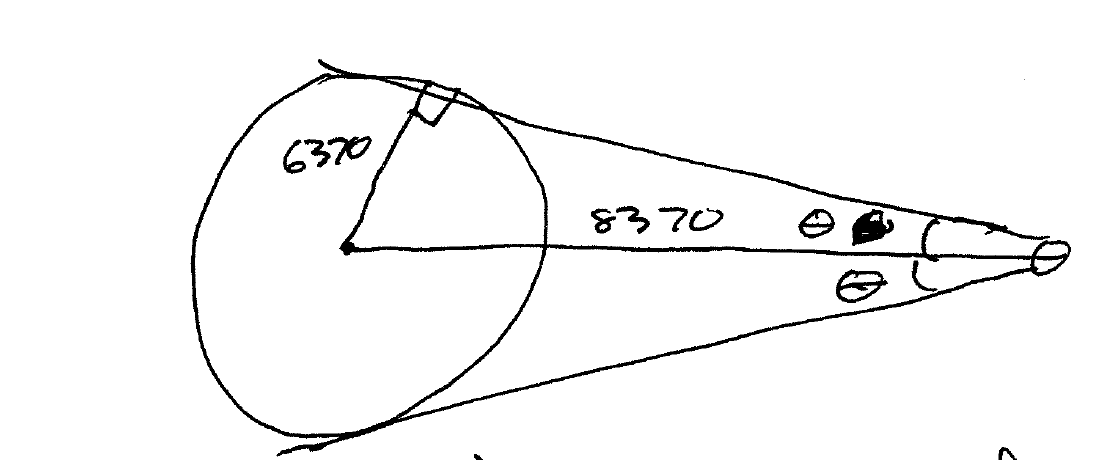
Fig. 25.1 Satellite problem setup#
25.2.2. But what is the flux?#
Question 4.31 requires the flux to the satellite if the radiance \(I\) is independent of direction (isotropic). If the radiance is \(I\) in all directions, we have to find the component of each element \(I d\omega\) in the direction of the satellite, which means we need to include \(\cos \theta\)
In Q4.31 Wallace and Hobbs neglect \(\cos \theta\), which overestimates the flux as \(2.21 I\) and introduces an error of about 20%.
import numpy  as np
theta = 0.864
cos2=np.cos(theta)**2.
print(f"{cos2=:.3f}")
result = 2*np.pi*(1 - cos2)/2.
print( f"{result=:.3f}" )
error = (result - 2.21)/result*100
print(f"{error=:.2f}%")
cos2=0.422
result=1.817
error=-21.65%
25.3. Question 4.31#
If the Earth radiates as a blackbody at an equivalent blackbody temperature \(T_E=255 \mathrm{~K}\), calculate the radiative equilibrium temperature of the satellite when it is in the Earth’s shadow.
25.3.1. Q4.31 Answer#
25.3.1.1. Power E (Watts) reaching the satellite#
Fig. 25.2 shows a section of solid angle at a latitude of about 45 deg on the satellite. How many Watts is arriving at that area? We know that the flux (arrow) \(F\) is arriving at an angle to the surface so we need to find the projection of the surface normal to the flux. By the definition of solid angle, the surface area of the pixel is:
where \(r\) is the radius of the satellite.
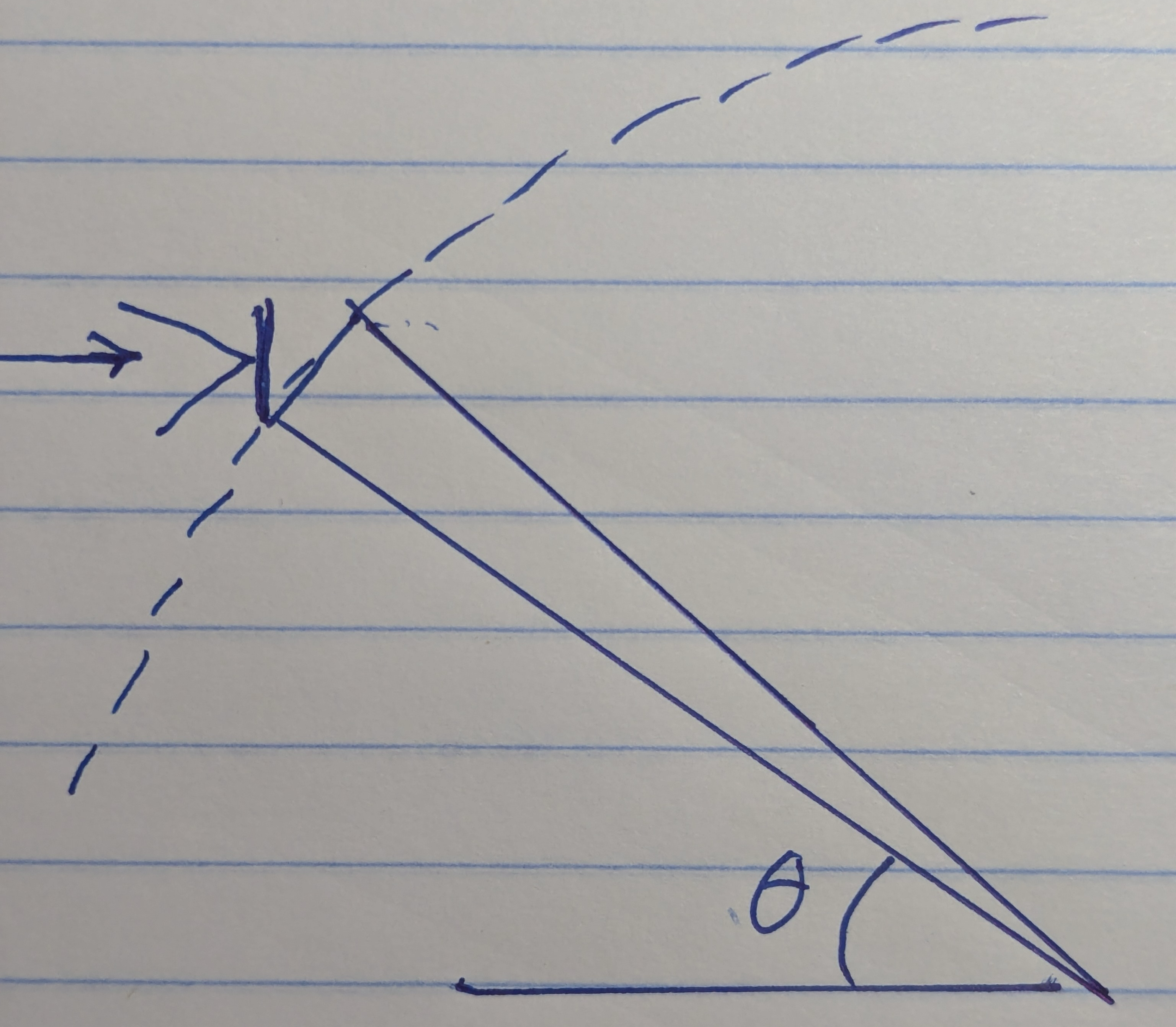
Fig. 25.2 Solid angle of a piece of the satellite surface at 45 deg latitude. The arrow represents the flux \(F = 1.87 I = 1.87 \left ( \frac{ \sigma T_E^4}{\pi} \right )\ (W\,m^{-2})\)#
Fig. 25.3 shows the projected area normal to the incoming flux. The watts \(dE\) illuminating that area is defined by:
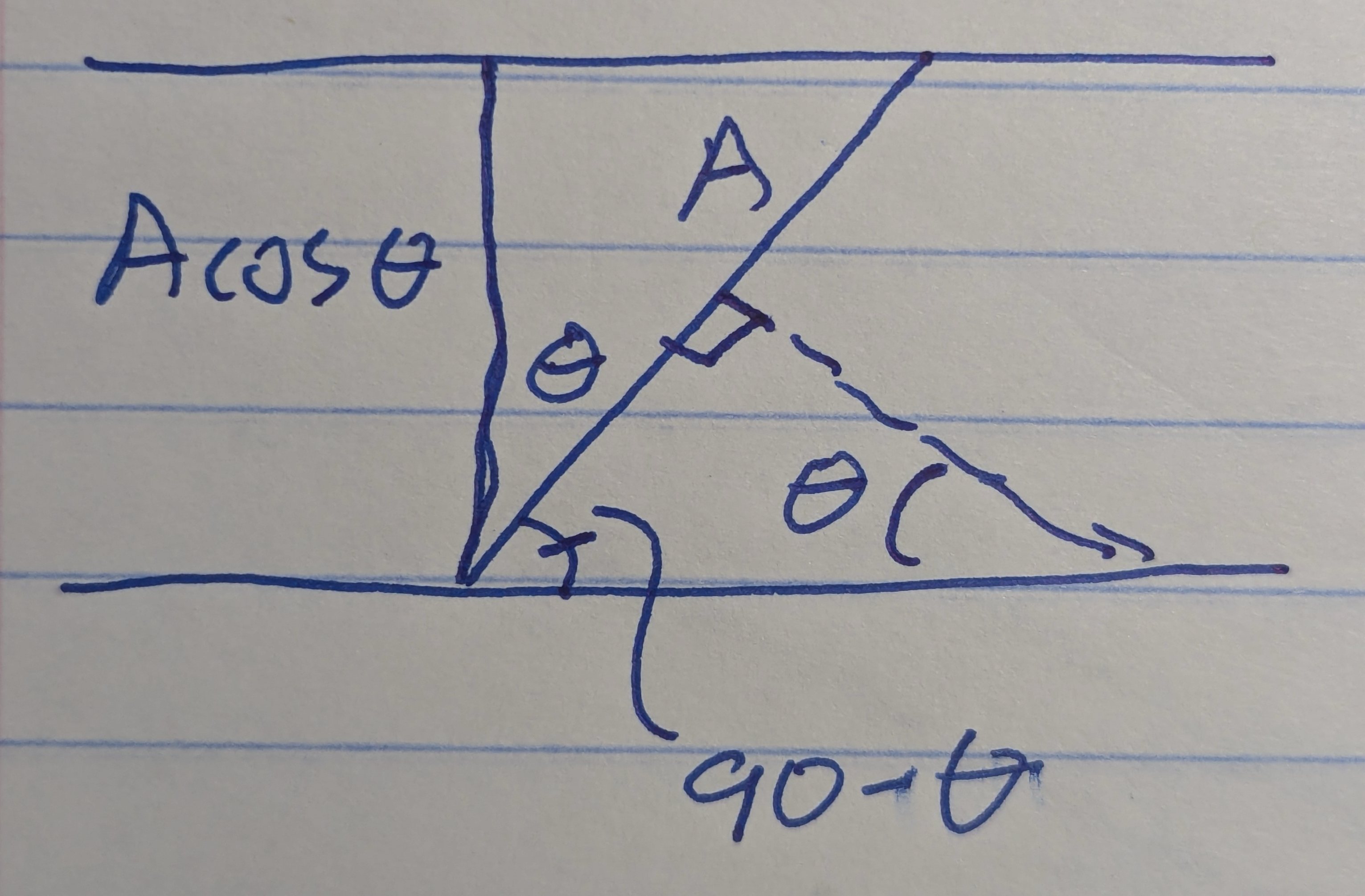
Fig. 25.3 Zoom in of Fig. 25.2 showing the projected area \(A \cos \theta\)#
Now do this integral over the side of the satellite facing the planet
25.3.1.2. Radiative equilibrium temperature#
The satellite needs to shed that power by radiating an equivalent amount over its entire surface, which will bring it to temperature \(T_s\). The power radiated will be:
and setting \(Q = E\) gives
Solving for \(T_s\):