69. 2014 final solutions#
69.1. 2014 final question 3#
See Notes on phasors
A cloud radar operates at \(\lambda=10\ cm\) with a PRF of 600 \(s^{-1}\). This figure shows the in-phase (coherence) plots of two wavetrains returning from a pulse pair separated by 1/600th of a second.
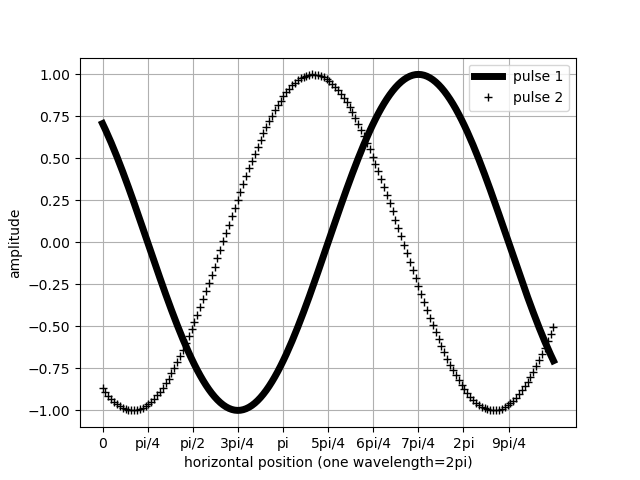
Fig. 69.1 Doppler pulse pair#
a) (4) Find the values of I and Q for the two pulses, and draw them on a phasor plot. The values at x = 0 are 0.707 for pulse 1 and -0.866 for pulse 2
import numpy as np
from numpy import pi,exp,cos,deg2rad,rad2deg
import matplotlib.pyplot as plt
phi1, phi2 = rad2deg(np.arccos(0.707)), rad2deg(np.arccos(-0.866))
phi1, phi2
(np.float64(45.00865166283799), np.float64(149.997089068812))
At this point we know they are both on the right side (postive cosine), but we don’t know whether they are in the top or bottom quadrant, because we don’t know the sin.
69.2. Now phase shift by 90 degrees#
Q1, Q2 = -np.sin(deg2rad(phi1)), -np.sin(deg2rad(phi2))
Q1, Q2
(np.float64(-0.7072135462503529), np.float64(-0.5000439980641702))
So sin(phi1) = 0.707 and sin(phi2) = 0.5
This means that both angles are in the upper quadrant, and phi1 = 45 degrees and phi2 = 150 degrees
see
b) (4) Calculate a “first guess” radial velocity with direction, plus two other velocities that are also consistent with this pulse pair, explaining your reasoning.
10 cm = 0.1 m positive angles are into the radar, negative angles are away from the radar
mrmax=0.1*600./4.
#smallest angle is 150 - 45.
angle=150 - 45.
vel1 = (150. - 45.)/180.*15  #8.75 m/s into the radar
print(f"{vel1=} m/s")
#second guess
angle2= angle - 360
vel2 = (angle2)/180.*15 #away from the radar
print(f"{vel2=} m/s")
vel1=8.75 m/s
vel2=-21.25 m/s
c) (5) Derive the doppler equation for the maximum unambiguous velocity with the help of a phasor diagram.
69.3. Code#
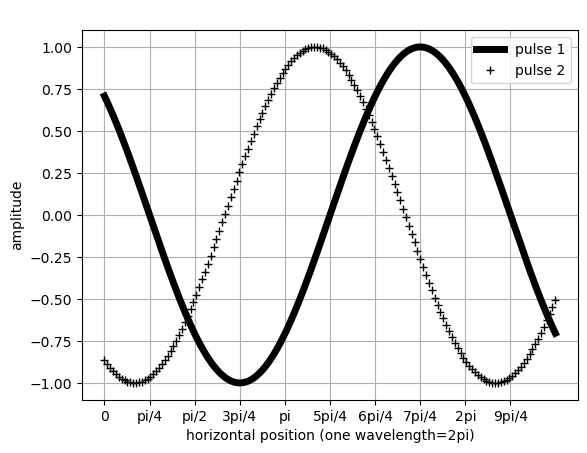
thetime=np.arange(0.,2.5*pi,0.05)
thewave=thetime
four5=45.*pi/180.
thirty=30*pi/180.
sixty=2.*thirty
onefifty=5.*thirty


fig1,axis1=plt.subplots(1,1)
axis1.plot(thewave,np.cos(thetime + four5),'k-',lw=5,label='pulse 1')
axis1.plot(thewave,np.cos(thetime + onefifty),'k+',lw=5,label='pulse 2')
axis1.set_xlabel('horizontal position (one wavelength=2pi)')
axis1.set_ylabel('amplitude')
axis1.set_title(' ')
pos=[0.,0.25*pi,0.5*pi,0.75*pi,1.*pi,1.25*pi,1.5*pi,1.75*pi,2*pi,2.25*pi]
labels=['0','pi/4','pi/2','3pi/4','pi','5pi/4','6pi/4','7pi/4','2pi','9pi/4']
axis1.grid()
axis1.set_xticks(pos)
axis1.set_xticklabels(labels)
axis1.legend(loc='best')
fig1.savefig('phase_shift_final.png')
#pulse1
I=0.707
Q= -(0.707) # = 0.707
#pulse2
I=-0.866
Q=-(-0.5) #=0.5
#first angle= +45
#pulse2=150 degrees
mrmax=0.1*600./4.
mrmax
15.0
np.cos(150/180.*np.pi)
np.cos(240/180.*np.pi)
np.float64(-0.5000000000000004)
#smallest angle is 150 - 45.
(150. - 45.)/180.*15  #8.75 m/s into the radar
angle=150 - 45.
#second guess
angle2=360. - angle
(angle2)/180.*15 #away from the radar
21.25