9. Solid angle and radiance#
My notes on Wallace and Hobbs Chapter 4, pp. 113-117. The purpose of this note is to introduce a basic measurement of electromagnetic radiation, the monochromatic radiance or monochromatic intensity, introduced on pp. 114 of Wallace and Hobbs. In the literature, there is no clear agreement about symbols. Wikipedia uses the letter L while Wallace and Hobbs use the letter I. Regardless, it has the units of “watts per meter squared per micron bin width per steradian field of view”. Below I try to untangle this, thinking in terms of how a satellite actually would measure \(I_\lambda\).
Wallace and Hobbs also show how the radiance is related to the irradiance, or radiant flux. Stull defines this quantity in terms of the monochromatic radiant flux emitted from a black surface:
Note that both \(I_\lambda\) and \(F_\lambda\) are vectors, and in this case the direction of propagation of \(F_\lambda\), called the zenith angle \(\theta\), is perpendicular to the emitting surface.
Note that there’s nothing special about the blackbody emission, they are just photons in space. Wallace and Hobbs show how to find the radiant flux given the radiance by integrating over a hemisphere:
To measure \(F\), you could use a photo diode to count the number of photons per second hitting a sensor, recording the wavelength of each photon. To get the photon energy use Stull eq. 2.12
where \(\nu\) is the frequency and c is the speed of light, and then use Planck’s constant (h) to convert frequency in Hz (\(s^{-1}\)) to energy in Joules
where \(h=6.62607 \times 10^{-34}\) \(J\,s\). Summing all the photon energies and dividing by the sensor area would give you the flux E. Spreading that flux coming in at zenith angle \(\theta\) over a surface that absorbs/reflects the photons would give you the irradiance \(F\).
Below we’ll go through each of these terms.
9.1. The \(\cos \theta\) effect#
To see why the zenith angle matters to the irradiance, consider this figure:
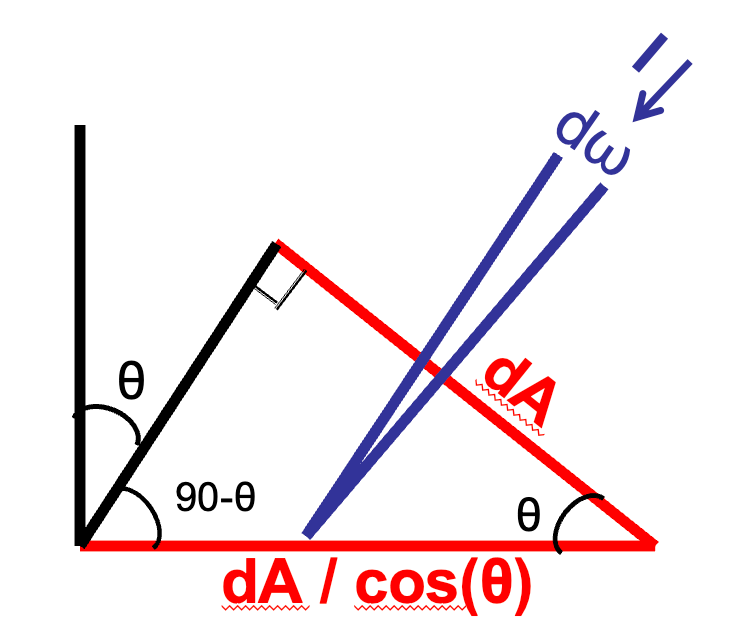
Fig. 9.1 The surface area depends on zenith angle#
This is why shadows are longer for a setting sun. The photons need to be spread over a larger area as the zenith angle \(\theta\) increases towards 90 degrees.
9.2. Monochromatic Radiance vs. total flux#
In the real world, instruments only measure photons that arrive within a limited field of view (i.e. the field of view of the telescope). The sensor also samples a limited range of wavelengths, both because the photo diode doesn’t respond equally to all wavelengths and because we are interested in particular wavelength ranges. The figure below shows the field of view for a typical airborne scanning radiometer:
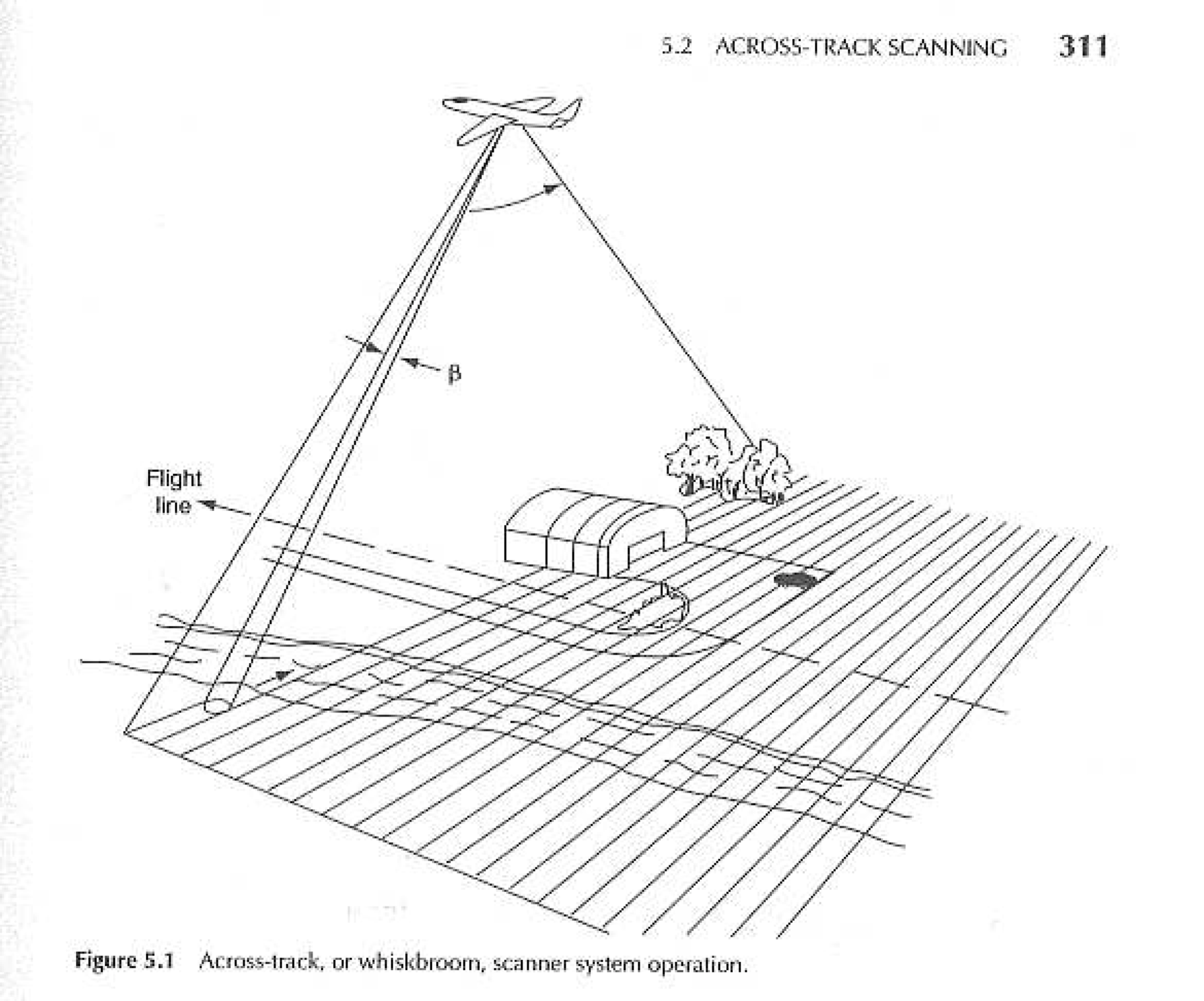
Fig. 9.2 Whiskbroom scanner#
The photons reaching the sensor through the telescope are separated into particular wavelength regions using a filter wheel or a beam splitter:
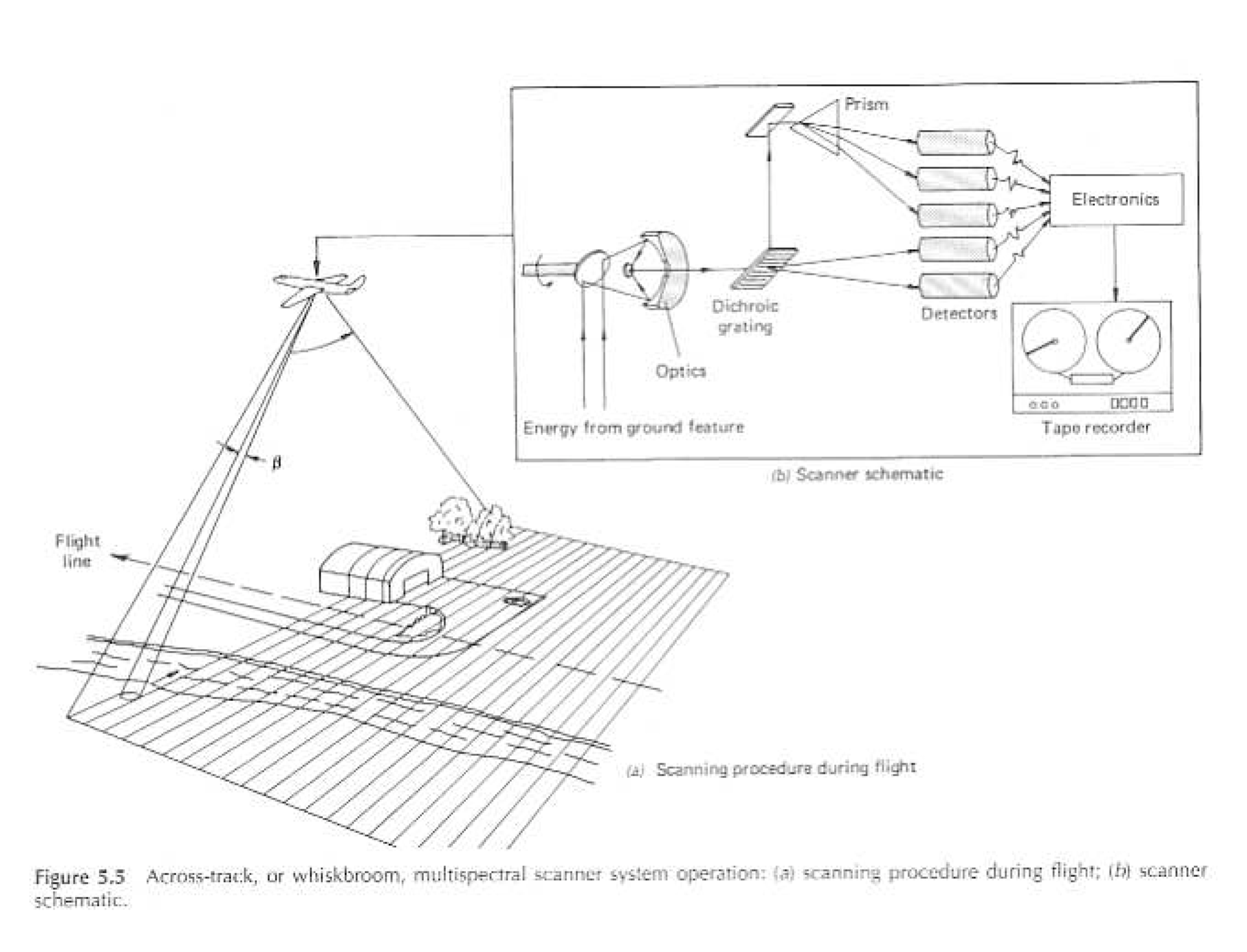
Fig. 9.3 Waveband filters#
9.3. Field of view#
Planar angle
Dealing with the fact that the telescope only sees photons coming from a specific set of angles means that we need a way to define those angles. In one dimension, we define an angle using radians:
where \(l\) is the arclength along a circle of radius \(r\) that defines the angle.
In the case that \(l\)=\(r\) the angle is 1 radian:
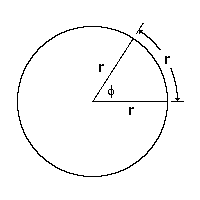
Fig. 9.4 Definition of planar angle#
The differential version of this is:
9.3.1. solid angle#
A pixel has two dimensions, which makes things more complicated. Consider the following spherical coordinate system:
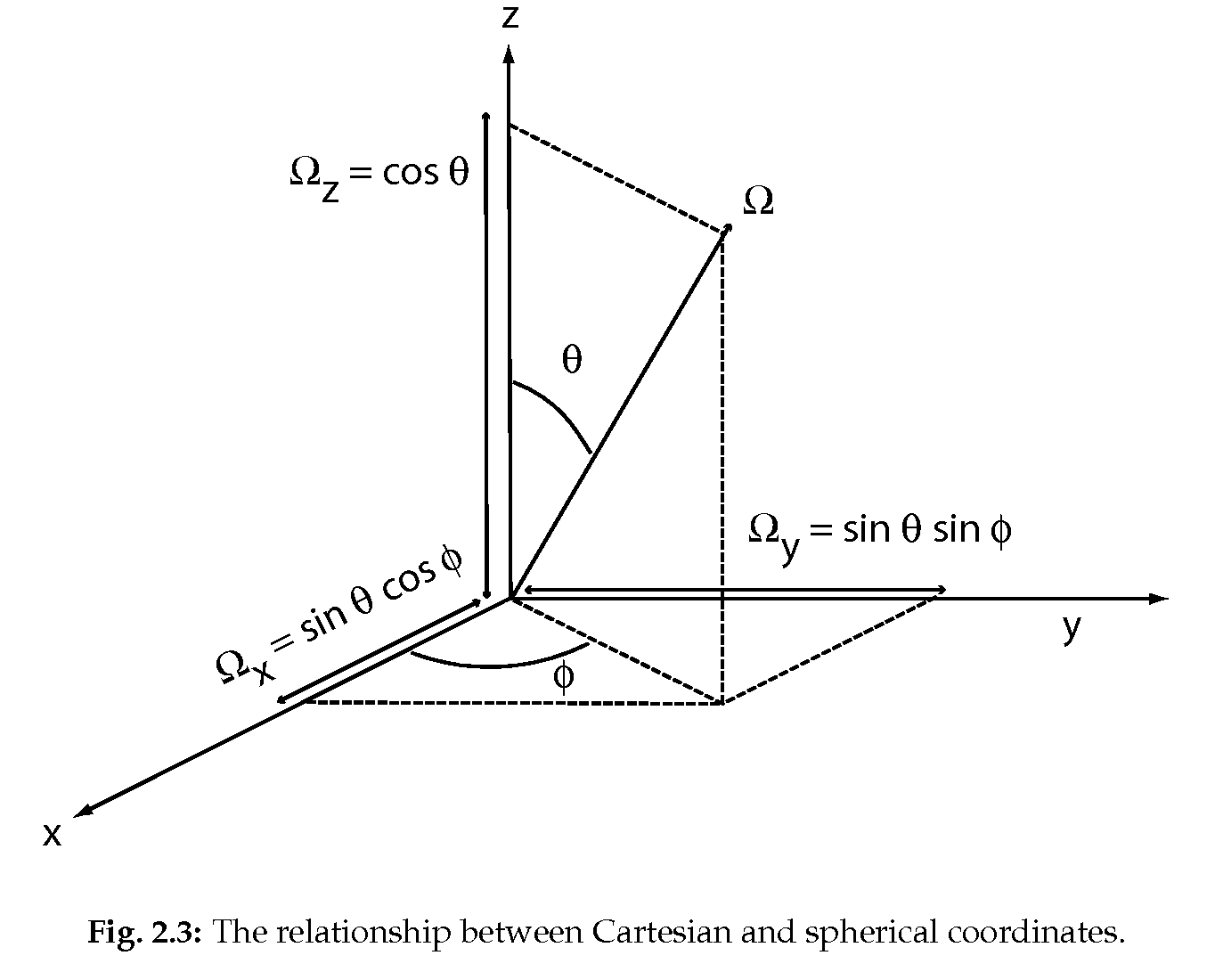
Fig. 9.5 Spherical coordinates#
\(\theta\) is called the “zenith angle”, and \(\phi\) is called the “azimuth angle”. Image our sensor is looking up in the direction given by \(\Omega\)
Suppose the telescope has a field of view that’s defined by a small angle \(d\phi\) in the azimuthal direction and \(d\theta\) in the zenith direction (these two angles would be equal if the field of view was a circular cone). A distance \(r\) away from the telescope, the arclength in the zenith direction is \(r d\theta\) by the definition of the planar angle. For the azimuth direction though, the planar angle is defined by the radius \(r \sin \theta\), which gives the distance from the vertical axis to the surface of the sphere of radius \(r\). That means that the area seen by the telescope at radius r is:
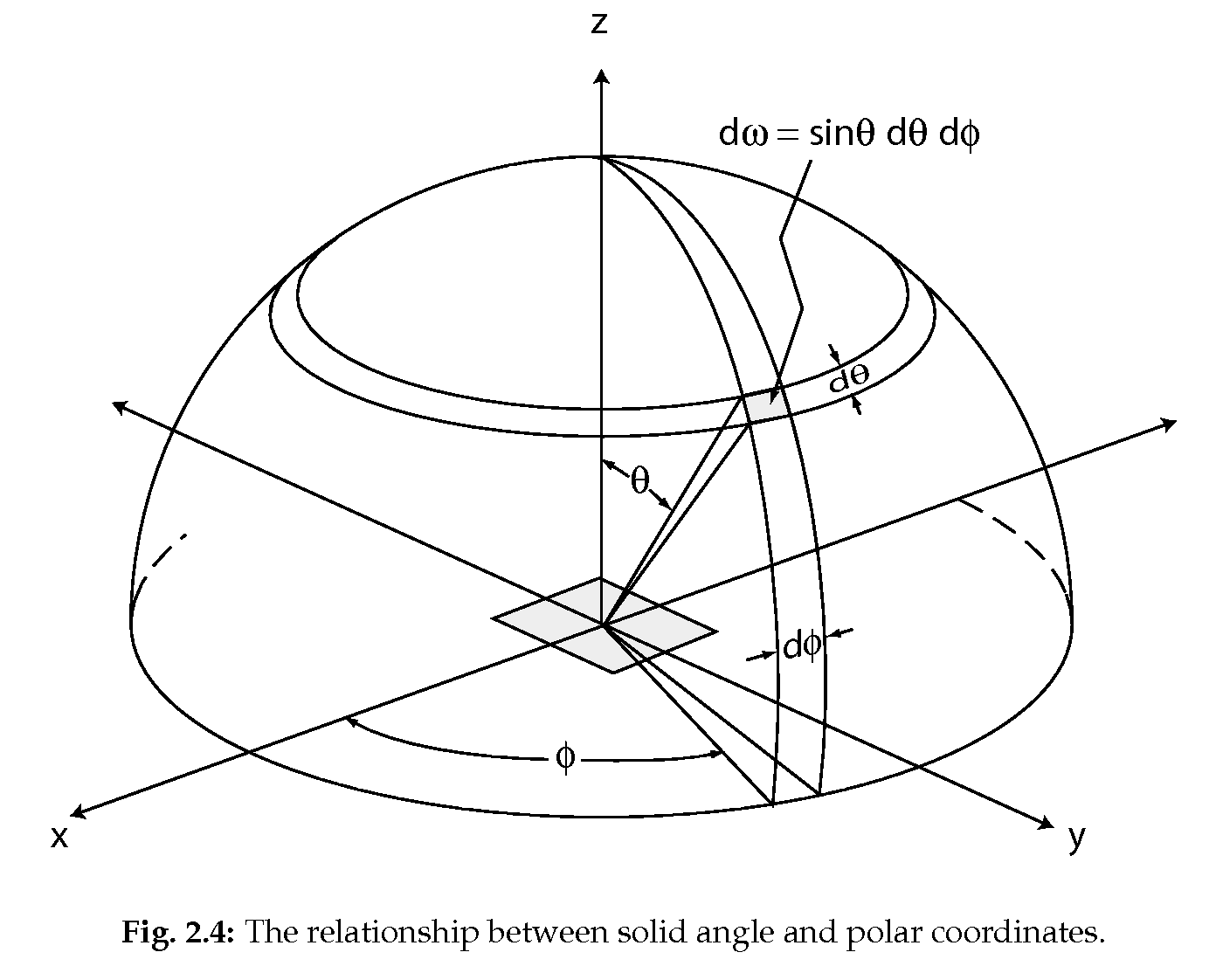
Fig. 9.6 Definition of solid angle#
Now that we know \(dA\) we can define the solid angle \(d\omega\) (steradians) by analogy with the planar angle:
Planar angle:
measured in radians
Solid angle:
measured in steradians
9.4. Monochromatic flux#
Handling the fact that we are only receiving photons in a specific wavelength range \(\Delta \lambda\) is straight forward: we just divide the measured flux \(F\) by the wavelength range to get \(F_\lambda\), the monochromatic flux:
and if I take \(\lim{\Delta \lambda \to 0}\)
so we can define \(\Delta F\) as the portion of the flux that is being transmitted by photons with wavelengths between \(\lambda \to \lambda + \Delta \lambda\)
9.5. Monochromatic radiance#
So if we know the monochromatic flux, and we know the field of view \(\Delta \omega\) of the telescope, then we can get the monochromatic radiance \(I_\lambda\) by:
units: \(W\,m^{-2}\,\mu m^{-1}\,sr^{-1}\).
The monochromatic radiance \(I_\lambda\) is the variable that the Modis thermal sensors deliver.
Switching to differentials again, we’ve got:
Note that both \(dF_\lambda\) and \(I_\lambda\) have a direction associated with them – their direction of propagation, which is perpendicular to the surface the photons are passing through.
Note that \(dF\) assumes that all the energy is contained in the small solid angle \(d \omega\), which is true for satellites because they are using a telescope to focus on a small pixel. If we want to instead measure all the energy crossing a surface from all directions, we need to integrate over all zenith and azimuth angles.
9.6. Some definitions#
The irradiance or radiant flux F is defined as the energy (Joules) crossing a unit surface (1 \(m^2\)) in unit time (1 second) so it has units of \(W\,m^{-2}\).
The radiance or radiant intensity is defined as the as the energy (Joules) crossing a unit surface (1 \(m^2\)) in unit time (1 second) over a unit solid angle, wo it has units of \(W\,m^{-2}\,sr^{-1}\)